
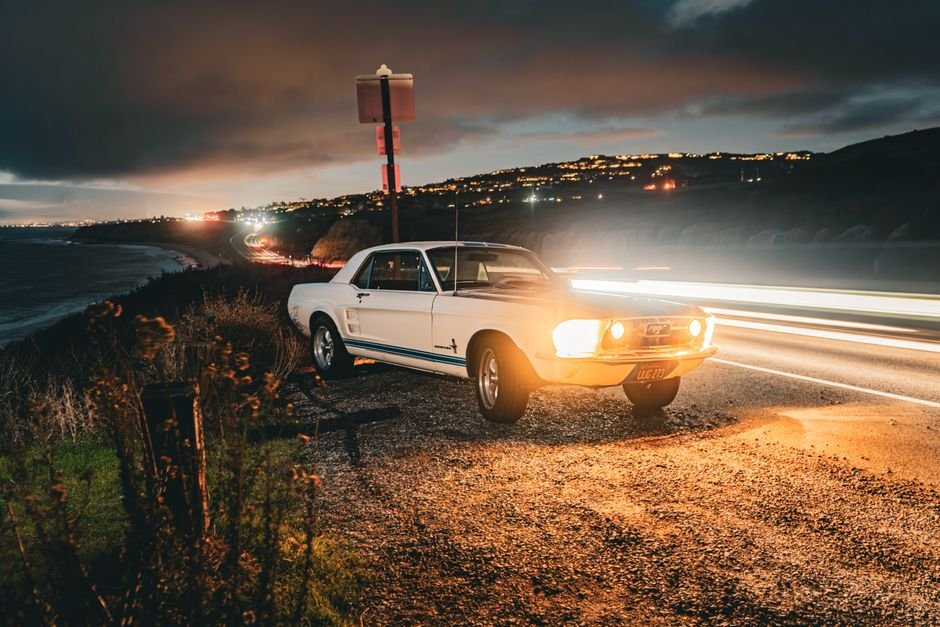
Leno’s Law classic cars rules are officially real. But if you’re rushing out to buy a 1979 Trans Am this weekend expecting an instant smog-check exemption, hold on. Governor Gavin Newsom signed Senate Bill 1392 on September 16, 2026, at Jay Leno’s Garage in Burbank. The actual benefits won’t kick in for another year and a half.
That gap matters if you’re weighing whether now is the right time to shop for a classic in California. Here’s what the law actually does, when it does it, and whether it should change your buying timeline.
What does Leno’s Law actually change?
Leno’s Law creates a new, phased-in smog-check exemption for collector vehicles from the 1976 through 1985 model years. That’s a group of cars stuck complying with emissions testing for decades. Qualifying vehicles must either carry collector-car insurance or be driven fewer than 1,000 miles a year. California’s older exemption for pre-1976 vehicles doesn’t change at all.
The rollout is gradual, not immediate. Starting January 1, 2028, qualifying vehicles made before the 1981 model year become exempt. The cutoff then advances by one model year every year after that. It reaches 1985 models in 2033.
Here’s the phase-in schedule in plain terms:
| Date exemption begins | Model years newly covered |
|---|---|
| January 1, 2028 | 1976–1980 |
| January 1, 2029 | Adds 1981 |
| January 1, 2030 | Adds 1982 |
| January 1, 2031 | Adds 1983 |
| January 1, 2032 | Adds 1984 |
| January 1, 2033 | Adds 1985 (full rollout complete) |
Should you buy a classic car in California now?
Yes, if you love a specific car and the price is right. Just don’t buy purely to dodge smog checks. That relief doesn’t arrive until 2028 at the earliest. Buying now still makes sense on the merits. Price, availability, and your own enjoyment matter more than a date on a calendar.
If your dream car is a 1978 Camaro or an early-80s BMW, waiting two years barely moves the math. You’d just spend that time not driving the car you actually want. Meanwhile, values on desirable 1976–1985 cars could climb once word spreads. Buying before that demand bump could actually save you money.
Will demand and prices spike once the exemption kicks in?
Some upward pressure on prices for 1976–1985 collector cars is likely. Enthusiasts will realize ownership just got simpler. But nothing dramatic should happen overnight, given the multi-year phase-in. Supporters of the bill have pointed out that these classics make up a tiny sliver of vehicles on the road. That limits how much attention the broader market will pay them at first.
The bigger driver of price movement will probably be word-of-mouth among collectors and clubs, not headline news. Say you’re eyeing a specific era, like a Malaise-era Corvette or an early Fox-body Mustang. Buying before 2028 means locking in a price before that community fully digests the change.
Does the smog exemption apply to every old car automatically?
No. This is not a blanket pass for anything built between 1976 and 1985. Owners still need to either insure the vehicle as a collector car or prove it’s driven less than 1,000 miles annually. The restrictions exist specifically to keep the exemption limited to cars that aren’t daily transportation.
That means a beat-up 1982 sedan someone commutes in every day won’t qualify just because of its age. You’ll need documentation to actually claim the break once your model year comes up. That’s either a classic-car insurance policy or mileage records.
What should shoppers do between now and 2028?
- Buy for the driving experience, not the paperwork. The car you love today is worth more to you than a future smog exemption.
- Get collector insurance sorted early. You’ll need it eventually to qualify anyway, so there’s no downside to setting it up now.
- Keep maintenance records. If you plan to lean on the mileage exemption instead, you’ll want a paper trail.
- Budget for smog checks until your model year phases in. A 1979 model doesn’t get relief until 2028. An ’84 doesn’t see it until 2032.
Still deciding between old-school muscle and something newer? Check out our take on whether buying a Mustang now beats waiting for Camaro’s return, which covers similar buy-now-versus-wait logic. And if smog compliance headaches have you nervous about diagnosing issues yourself, our guide on whether a cheap OBD2 scanner is worth it is a smart companion read for any older-car owner.
My take: don’t let Leno’s Law dictate your timeline. Buy the classic you actually want when you find the right one. Treat the eventual smog relief as a nice bonus, not the reason to buy.
FAQ
When does Leno’s Law actually take effect?
The first phase begins January 1, 2028, covering vehicles made before the 1981 model year. The exemption then expands by one model year annually. It covers 1985 models by 2033.
Do pre-1976 cars need to do anything differently?
No. California has exempted vehicles from before the 1976 model year from smog checks for years. Leno’s Law doesn’t change that existing rule at all.
What counts as a “collector vehicle” under the new law?
Owners qualify by either carrying collector-car insurance on the vehicle or by proving it’s driven fewer than 1,000 miles per year. Both requirements exist to separate true collector cars from daily drivers.
Should I wait until 2028 to buy a 1977 or 1978 car?
Not really. Smog-check costs on a well-maintained classic are usually manageable. Waiting also risks paying more once demand for pre-1981 cars picks up ahead of the exemption.