
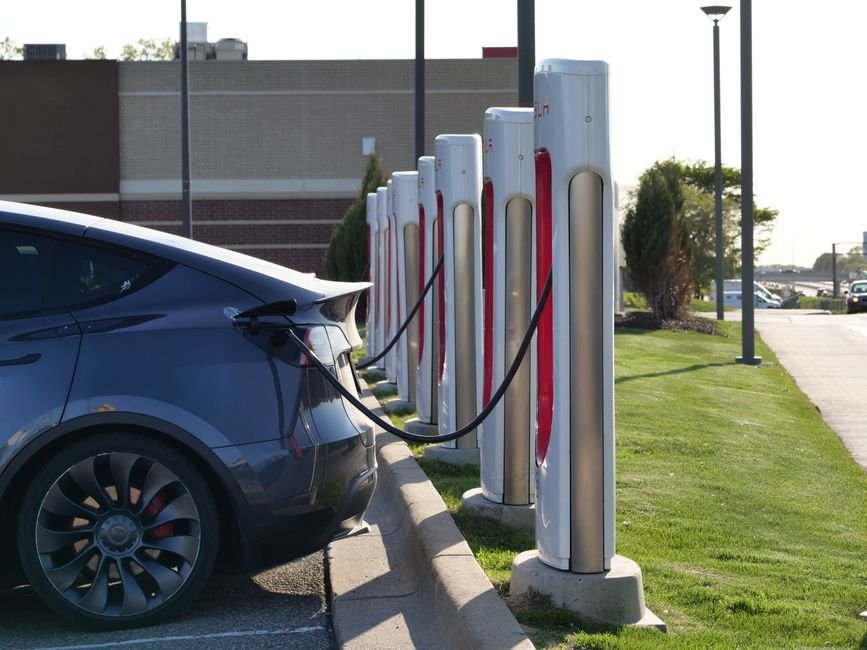
Tesla Supercharger is no longer the best EV charging network in America. At least, not according to the group that’s been measuring this for six years. J.D. Power’s 2026 U.S. Electric Vehicle Experience Public Charging Study just knocked Tesla out of first place for the first time ever. It didn’t even land in second.
That’s a genuinely big deal. Superchargers have been the gold standard for half a decade. They’re the reason so many non-Tesla owners went out and bought NACS adapters in the first place. Now three newer, automaker-backed networks have leapfrogged it.
Who actually won the best EV charging network title in 2026?
IONNA took the top spot with a score of 807 out of 1,000. Mercedes-Benz Charging Network followed at 797, and Rivian Adventure Network came in at 755. Tesla Supercharger landed fourth at 701, a slight drop from 709 the year before.
All three winners are relatively young. IONNA launched in February 2024 as a joint venture. BMW, GM, Honda, Hyundai, Kia, Mercedes-Benz, Stellantis, and Toyota all backed it. Basically every major automaker except Tesla, Ford, and Rivian pooled money into one network. This was IONNA, Mercedes-Benz, and Rivian’s first year being eligible for the award. All three walked in and beat the incumbent anyway.
| Network | 2026 J.D. Power Score | Backing |
|---|---|---|
| IONNA | 807 | BMW, GM, Honda, Hyundai, Kia, Mercedes-Benz, Stellantis, Toyota |
| Mercedes-Benz Charging Network | 797 | Mercedes-Benz + MN8 Energy |
| Rivian Adventure Network | 755 | Rivian |
| Tesla Supercharger | 701 | Tesla |
| Industry average | 666 | — |
Why did Tesla drop instead of just holding steady?
Tesla’s actual score barely moved. But the newcomers built a better experience from scratch, and it shows where it counts. J.D. Power found the new networks beat the average most in ease of charging, charging speed, and charger availability. Sometimes by more than 100 points.
Part of it is design. IONNA’s “Rechargery” sites put both NACS and CCS1 plugs on every stall. Nobody needs an adapter. Many locations also add canopies, restrooms, and food options that make waiting less miserable. Mercedes-Benz is chasing a similar amenity-heavy strategy with its network, built alongside MN8 Energy. It already has over 650 stalls live, with plans for 2,500 chargers across 400-plus hubs by decade’s end.
Does this mean Tesla Superchargers actually got worse?
No. Tesla’s network is still huge and still reliable. It just isn’t growing its lead the way it used to, while three well-funded rivals caught up fast. Tesla still runs roughly 36,900 fast-charging stalls nationwide. That’s more than half of all public DC fast charging capacity in the U.S., and more than the next several networks combined.
That scale matters more on a real road trip than on a satisfaction survey. IONNA has only around 120 to 150 stations open as of this summer. Mercedes-Benz has a few hundred stalls. Rivian’s network is smaller still. If you’re driving cross-country tonight, Tesla remains far easier to find. Its charging reliability, often cited north of 99% uptime, is still the industry benchmark.
What’s actually driving the shakeup across the whole industry?
Charging reliability is improving everywhere. The fight has shifted from “will this charger even work” to something more subtle: who offers the smoothest, cheapest, least confusing experience. J.D. Power’s own data shows the share of drivers who pull up and leave without charging dropped to 12%. That’s the lowest ever recorded in the study.
- Charger availability saw the single biggest year-over-year jump, up 27 points industry-wide.
- Safety and cost ratings each rose 18 points as more stations added lighting, security, and clearer pricing.
- Slow charging remains the most common complaint, though it’s declining fast as older hardware gets replaced.
- Federal funding for public charging corridors is flowing again after last year’s freeze. About $885 million in NEVI money went out to states in fiscal year 2026.
Should this change what EV you buy?
Not by itself. But it’s a good reminder that Tesla’s charging advantage, once its single biggest selling point, is shrinking every quarter. If you’re cross-shopping a Rivian or a Mercedes EV against a Tesla, the charging gap that used to favor Tesla heavily is now much closer to a coin flip. It depends on where you actually drive.
For anyone still deciding whether an EV makes sense this year, charging network quality is just one input. Cost, incentives, and your daily driving pattern matter just as much. Our EV decision framework for 2026 walks through all of it. If you want the full math on fuel savings versus a gas car, check our guide to EV total cost of ownership.
If you’re weighing a Tesla against the growing field of NACS-native rivals, it’s worth reading how the Rivian R2 stacks up against the Tesla Model Y. Or check whether the Tesla Model Y L’s price tag still makes sense now that Supercharger isn’t the automatic tiebreaker it used to be.
My take: still charge at Tesla, but keep an eye on IONNA
I’d still point most road-trippers toward Superchargers today. There are simply so many more of them, and Tesla’s uptime record is hard to beat. But IONNA and the Mercedes-Benz network are the ones to watch over the next two or three years. Both plan to scale up toward tens of thousands of planned stalls.
FAQ
Can non-Tesla EVs still use Tesla Superchargers in 2026?
Yes. Most Superchargers are open to non-Tesla EVs, either through a built-in NACS port or a NACS-to-CCS adapter. Payment runs through the Tesla app. Roughly 70-80% of U.S. Supercharger stations now allow non-Tesla vehicles.
What is IONNA and who owns it?
IONNA is a fast-charging network launched in 2024. It’s a joint venture between BMW, GM, Honda, Hyundai, Kia, Mercedes-Benz, Stellantis, and Toyota. Its stations, branded “Rechargery,” put both NACS and CCS1 plugs on every stall, so no adapter is required.
Is Tesla Supercharger still the most reliable network overall?
By raw uptime, yes. Tesla still posts some of the best reliability numbers in the industry, thanks to owning its entire hardware and software stack. It just no longer wins the overall satisfaction score once cost, ease of payment, and amenities get factored in.
Does charging network quality really affect an EV’s resale value or ownership cost?
It can, especially for road-trip-heavy owners who rely on public fast charging often. If you mostly charge at home, network rankings matter far less. What you paid and how the car holds up matter more, which is exactly what our used EV buying guide breaks down.