
Land Rover just answered the question it’s been dodging for five years. Yes, the first-ever electric Range Rover really does cost about $25,000 more than the base gas model. And no, it doesn’t look any different for the money. Order books are open now, and the numbers are finally locked in.
The Range Rover Electric starts at $138,000 before destination. That’s $140,450 to $140,550 once the delivery fee is added. Compare that to the base gas SE, which runs $113,300 with destination included. That’s a gap of nearly $25,000 for a badge that looks almost identical on the outside.
How much more does the Range Rover Electric actually cost?
The electric SE costs about $25,000 more than the gas six-cylinder SE. But it’s only around $9,100 to $9,200 more than the plug-in hybrid SE. That second number matters more, because the PHEV is the electric model’s real competition, not the base gas engine.
| Trim | Powertrain | Starting Price (w/ destination) |
|---|---|---|
| SE | Gas I6 (mild hybrid) | $115,750 |
| SE | Plug-in hybrid (P550e) | $131,350 |
| SE | Electric | $140,450-$140,550 |
| Autobiography | Electric | $177,250 (same as V8) |
| SV Ultra | Electric | $255,250 (same as V8) |
That’s a deliberate pricing strategy, not an accident. Land Rover has said outright that it expects EV buyers to pay a premium rather than a discount. That runs opposite to what most luxury brands are doing right now. It’s worth reading our breakdown on whether an EV actually makes sense for you in 2026 before you commit to that kind of premium.
What do you actually get for the extra money?
You get more power, a quicker off-the-line feel, and a genuinely quiet cabin. But you give up towing capacity and some off-road ground clearance compared to the V8. It’s a fair trade for city and highway drivers. It’s less so for anyone who tows regularly.
The Electric packs a 118.5-kWh battery feeding two motors. Combined output is 542 horsepower and 627 lb-ft of torque. That’s more torque than any Range Rover has ever produced. It’s enough for a 0-60 mph time of 4.3 seconds, just a tick quicker than the V8’s 4.4-4.5 seconds. EPA range lands at 333 miles. Land Rover’s own WLTP figure is closer to 372 miles.
Charging is genuinely quick for a vehicle this size. Land Rover says a 350-kW DC fast charger can take the battery from 10-80% in about 22 minutes. Ten minutes on a fast enough charger adds roughly 125 miles. At home on a Level 2 charger, expect around 7 hours for a full charge.
Does the Range Rover Electric look any different?
Barely. The Electric shares its body with the current fifth-generation Range Rover, which launched in late 2021. The only changes are a smoothed-over grille, new wheels, and a reworked underbody. Those tweaks shave the drag coefficient slightly and add roughly 10 miles of highway range.
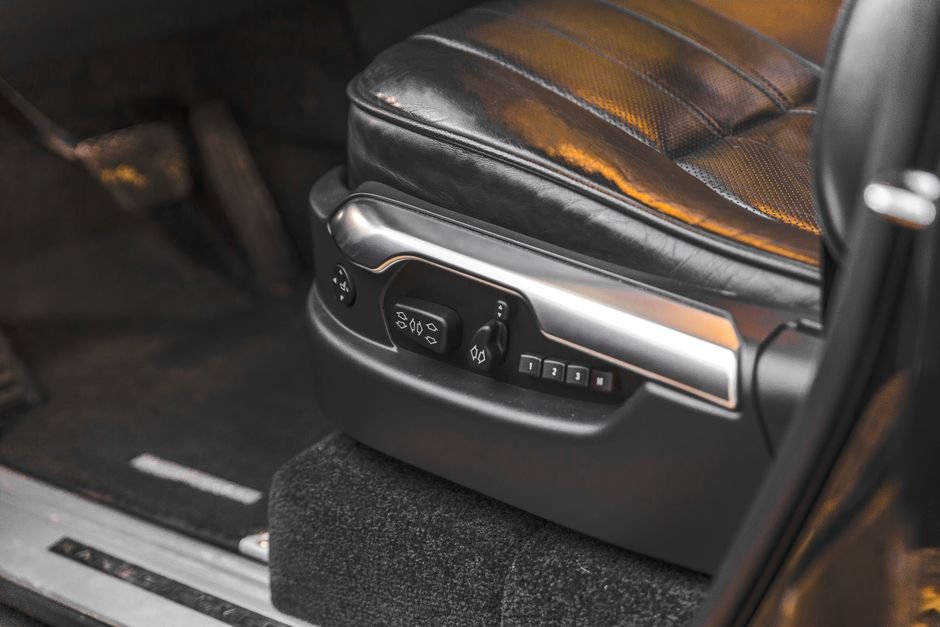
Inside, it’s the same cabin you’d get in a gas Range Rover. You just get EV-specific graphics for range prediction and battery software updates. If you were hoping for a dramatically different look to justify the price jump, you won’t find one here. This is a car built for buyers who want the badge, not a statement.
Is the Range Rover Electric worth it over the gas SE?
For most buyers, no. The plug-in hybrid SE gets you nearly identical performance and real electric commuting range for $9,000 less. You also avoid range anxiety on long trips. The full EV only makes sense if you’re committed to going gas-free and can live with less towing capability.
Land Rover’s own research found that a huge share of prospective Electric buyers are already EV owners moving over from other brands. Plenty more are brand-new to EVs entirely. That tells you this car isn’t trying to convert skeptics. It’s there for people who’ve already made peace with charging stops and just want their electric SUV to say Range Rover on the back.
If you’re cross-shopping other big, expensive EVs in this space, it’s worth also looking at how the Gravity GT-S stacks up against the Cayenne Turbo Electric, or how Cadillac’s Escalade IQ handles the size-versus-price tradeoff. And before signing anything, run the numbers on EV total cost of ownership. Insurance, charging, and depreciation on a six-figure electric SUV add up fast.
FAQ
When does the Range Rover Electric go on sale?
Order books opened in September 2026 for the 2027 model year, though Land Rover hasn’t confirmed exact delivery timing yet.
How does the Range Rover Electric’s range compare to rivals?
Its EPA-rated 333 miles sits roughly in the middle of the luxury electric SUV pack. It’s a bit behind the Mercedes EQS SUV and Volvo EX90, and a bit ahead of the BMW iX’s top trims.
Can the Range Rover Electric still tow and go off-road?
Yes, but with less towing capacity than the V8 version. It also has slightly less ground clearance and approach angle than some rivals. Land Rover says off-road capability remains a core strength.
Is the plug-in hybrid a better value than the full EV?
For most buyers, yes. The P550e plug-in hybrid delivers nearly the same power for about $9,000 less. It also adds gas-engine backup for long trips.