
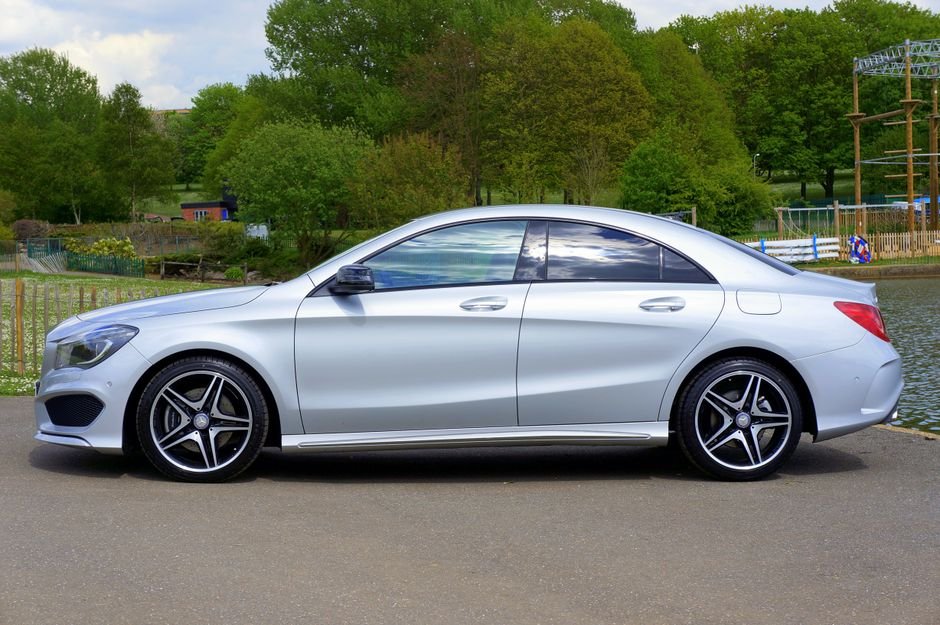
The 2026 Mercedes CLA 250+ Electric and Tesla Model 3 are fighting for the same buyer. That’s someone who wants a genuinely nice electric sedan without spending $60,000-plus. If you want the affordable luxury EV with more range and faster charging, the CLA 250+ wins on paper. If you want better overall value and the biggest charging network, the Model 3 still takes it.
Both cars are new for 2026 in meaningful ways. The CLA rides on Mercedes’ first ground-up electric platform. The Model 3 continues to get quiet trim and pricing shuffles. Let’s break down where each one actually pulls ahead.
How much does each one cost in 2026?
The Mercedes CLA 250+ starts around $47,250. The Tesla Model 3 starts at $38,630 for the base Standard trim. That’s roughly an $8,600 gap before options. It only grows if you step up to a faster Model 3 or the all-wheel-drive CLA 350.
| Model | Starting Price | EPA Range | 0-60 mph |
|---|---|---|---|
| Tesla Model 3 Standard | $38,630 | 321 miles | 5.8 sec |
| Mercedes CLA 250+ Electric | $47,250 | 374 miles | 6.7 sec (0-62) |
| Tesla Model 3 Premium RWD | ~$44,130 | 363 miles | 4.9 sec |
| Tesla Model 3 Premium AWD | $47,490 | 346 miles | 4.2 sec |
| Mercedes CLA 350 4Matic | $49,800 | 312 miles | ~5.0 sec |
| Tesla Model 3 Performance | $54,990 | 309 miles | 2.9 sec |
Line the trims up side by side and one matchup stands out. The Model 3 Premium RWD, at around $44,130, is the closest price-for-range rival to the CLA 250+. Tesla still wins on sticker price at every trim level, though.
Which EV has more range and charges faster?
The CLA 250+ has the range edge on paper. It’s rated at up to 374 miles versus 363 miles for the quickest Model 3 trim. It also charges dramatically faster thanks to its 800-volt electrical system. That’s a real advantage for road trips, even if Tesla’s charging network is still more widespread.
Mercedes built the CLA on its new MMA platform specifically to compete with 800-volt EVs like the Porsche Taycan. It shows in the charging numbers. The CLA 250+ can add 100 miles of range in about seven minutes at a compatible fast charger. Few EVs at any price can match that pace. Edmunds’ own real-world range test called the result outstanding for an EV in this price range, and the car actually outperformed its window-sticker number.
Tesla’s advantage isn’t raw charging speed. It’s the Supercharger network itself. With NACS ports standard and thousands of stations nationwide, a Model 3 owner rarely has to think twice about where to plug in. Each session may take a bit longer than the CLA’s, but finding a charger is easier.
Is the CLA 250+ actually more luxurious inside?
Yes, the CLA 250+ feels like the more upscale car inside. It has nicer materials and Mercedes’ MBUX system now runs on AI-driven voice assistance. The Model 3 counters with a famously minimalist cabin. Some drivers love it; others find it frustrating, especially since nearly every function routes through the center touchscreen.
Neither car is perfect, though. Reviewers have knocked the CLA for touch-sensitive controls that can be distracting to use. It also has a smaller trunk than you’d expect from a sedan this size. If dash-mounted physical buttons matter to you, it’s worth reading our look at why buttons are making a comeback in modern cars before you commit to either one.
Which one wins on performance and driving feel?
Tesla wins decisively on straight-line speed at every comparable price point. The Model 3 Performance hits 60 mph in 2.9 seconds. Even the mid-tier Premium AWD beats the CLA 250+’s 6.7-second 0-62 time by a wide margin.
The CLA 250+ isn’t slow by normal-car standards. Its single motor makes 272 horsepower, plenty for daily driving and highway merges. But if acceleration is a priority, Tesla’s dual-motor Model 3 trims simply have more punch for similar money.
Do either of these qualify for a federal EV tax credit in 2026?
No. The federal $7,500 new-EV tax credit ended for vehicles acquired after September 30, 2025. Neither the CLA 250+ nor the Model 3 comes with that discount anymore. Shoppers now need to lean on manufacturer incentives, state-level rebates, or lease deals instead.
That change makes sticker price comparisons more important than ever. There’s no federal cushion softening the CLA’s premium over the Model 3 anymore. It’s worth checking our roundup of current EV cash-back deals before you sign anything, since automaker incentives are doing a lot more heavy lifting this year.
So which affordable luxury EV should you actually buy?
For most shoppers, the Tesla Model 3 remains the smarter buy in 2026. It costs thousands less. It accelerates harder. And it plugs into a charging network that’s still unmatched for road trips.
But the CLA 250+ isn’t just a badge premium. It earns its price with genuinely faster charging, longer EPA range, and a nicer cabin. If you road-trip often and hate waiting at chargers, or you simply want the three-pointed star experience, the CLA 250+ is worth the extra money. Everyone else should save the $8,000-plus and buy the Tesla.
FAQ
Is the Mercedes CLA 250+ Electric bigger than a Tesla Model 3?
They’re close in footprint. The CLA is a compact sedan similar in size to an Audi A3, with a longer wheelbase. The Model 3 is a slightly larger mid-size sedan with more usable trunk and frunk space.
Does the CLA 250+ come in all-wheel drive?
Yes. The CLA 350 4Matic adds all-wheel drive and starts at $49,800. It trades some range compared to the rear-wheel-drive CLA 250+.
Which car has better resale value, the CLA or the Model 3?
Tesla has historically held resale value better than most luxury EV rivals. That’s thanks to brand demand and its charging ecosystem. It’s too early to know how the all-new CLA will depreciate, since it just launched for 2026.
Can I still get a tax credit on either car?
Not the federal purchase credit. It expired for vehicles acquired after September 30, 2025. Some states and utilities still offer their own EV rebates, so it’s worth checking local programs before you buy.